

Hammock Stand vs. Hanging Hardware: Which Setup Is Right for You?

Audio Version
Hammock Stand vs. Hanging Hardware: Which Setup Is Right for You?
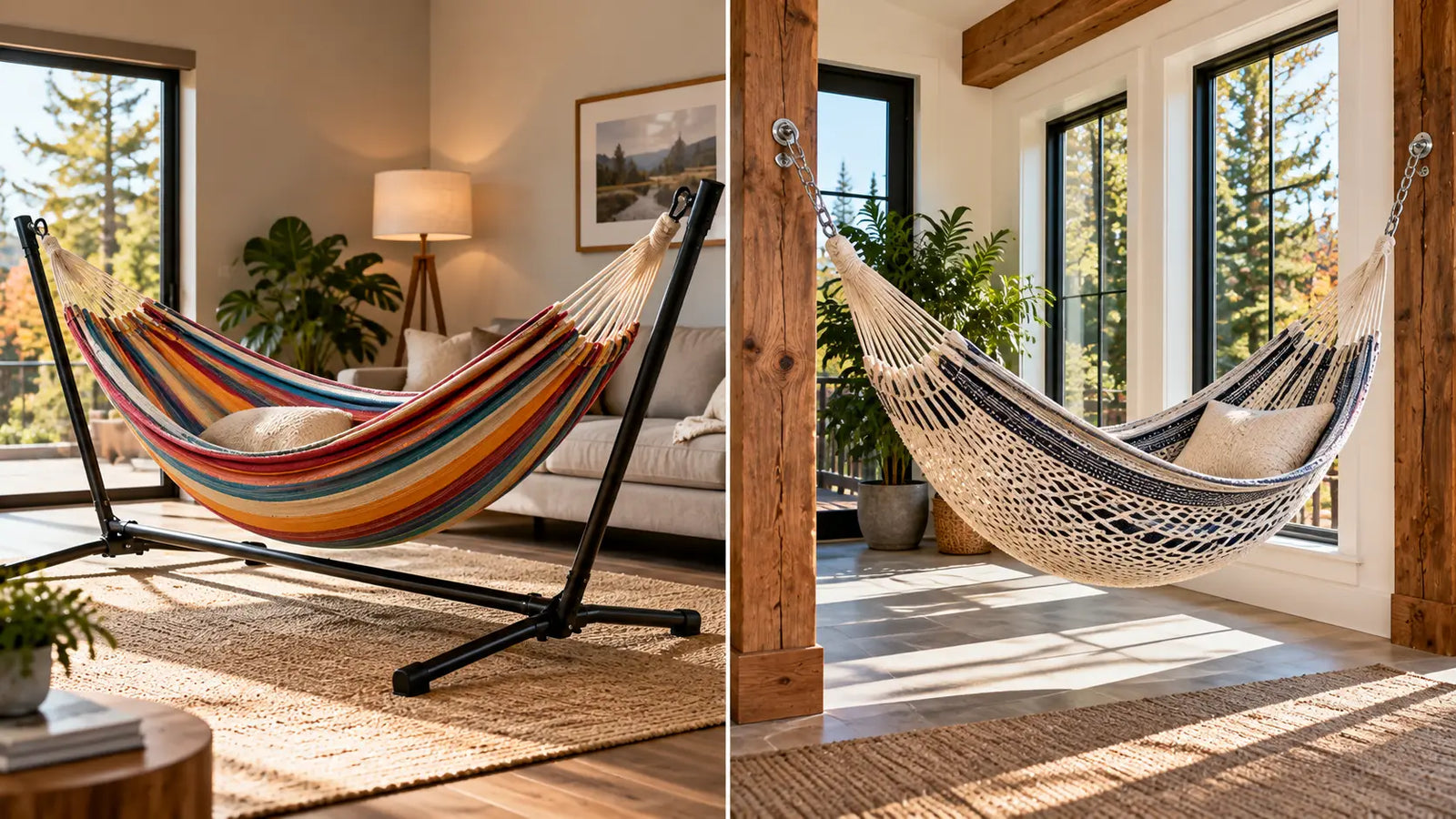
Once you have chosen a hammock, another decision remains:
How are you going to hang it?
For many homeowners, especially as hammocks move indoors for fall and winter, the choice comes down to two basic approaches:
a freestanding hammock stand or fixed hanging hardware.
Both can create an excellent setup.
But they solve different problems.
Quick answer: Choose a hammock stand if you want a portable setup, do not want to drill into walls or ceilings, or are unsure whether your home's structure provides suitable anchor points. Choose fixed hanging hardware if you have appropriate structural supports, want to save floor space and prefer a permanent installation. In either case, verify compatibility and capacity before using the hammock.
Hammock Stand vs. Hanging Hardware at a Glance
| Feature | Hammock Stand | Fixed Hanging Hardware |
|---|---|---|
| Drilling required | No | Usually yes |
| Permanent installation | No | Usually yes |
| Portability | High | Low |
| Floor space | More | Less |
| Structural anchors required | No | Yes |
| Easy to relocate | Yes | No |
| Setup flexibility | High | Location-specific |
| Best for | Renters, flexible rooms, easy setup | Permanent installations, limited floor space |
Neither option is universally better.
The correct choice depends on your home, your hammock and how permanent you want the setup to be.
What Is a Hammock Stand?
A hammock stand is a freestanding frame designed to support a hammock without requiring trees, posts, walls or ceiling anchors.
For traditional hammocks without spreader bars, one example is the Universal Hammock Stand for Non-Spreader-Bar Hammocks.
Its footprint is approximately 9.5 feet long by 4 feet wide, and it is designed for traditional hammocks such as Brazilian, Mayan and Nicaraguan styles.
It requires no separate hanging hardware and can be assembled without tools.
That makes it particularly useful when you want to enjoy a hammock indoors without making permanent changes to the room.
You can compare it with other options in the Hammock Stand collection.
What Is Fixed Hanging Hardware?
Fixed hanging hardware connects a hammock directly to appropriate structural anchor points.
Depending on the installation, those anchor points might include:
-
structural wall framing;
-
ceiling joists;
-
exposed beams; or
-
properly installed wooden posts.
The Hammock Universe Hammock Chain Hanging Kit, for example, provides hardware for connecting a hammock to suitable structural supports and offers chain adjustment for positioning.
Unlike a stand, this type of installation depends entirely on the strength and suitability of the structure receiving the hardware.
Never attach a hammock directly to drywall or another non-structural surface.
If you are uncertain about the framing or suitability of an anchor point, have it evaluated by someone qualified to do so.
Browse additional Hammock Hanging Accessories if you are planning a fixed or adjustable suspension setup.
Which Option Is Easier?
For most people, a stand wins on initial simplicity.
You assemble the stand, adjust it for the compatible hammock and attach the hammock.
There is no need to:
-
locate structural framing;
-
drill permanent holes;
-
calculate two permanent mounting locations; or
-
modify the building.
That can be especially appealing in a rental property or in a room where you may later change the furniture layout.
Fixed hardware requires more planning at the beginning.
Once correctly installed, however, the hammock itself can usually be attached or removed quickly.
So there are really two types of convenience:
A stand is easier to install and move.
Fixed hardware is less visually and physically intrusive once installed.
Which Option Uses Less Space?
Fixed hardware usually wins here.
A hammock attached directly between structural anchor points does not need a large steel frame underneath and around it.
That can make a fixed installation useful in a room where floor space is valuable.
A freestanding stand has its own footprint.
For example, the Universal Non-Spreader-Bar Stand requires roughly 9.5 feet by 4 feet.
That footprint needs to remain clear enough for both the stand and safe access to the hammock.
This is why How to Measure Your Space for a Hammock: Distance, Height & Stand Compatibility should be part of the decision before you buy either setup.
Which Is Better for Renters?
Usually, a hammock stand.
A stand requires no permanent wall or ceiling anchors, making it much easier to remove when you move.
It can also travel with you to another room, another apartment, a cottage or a patio.
If you rent, do not assume you can install structural hardware simply because a wall appears suitable.
Permanent mounting may require both structural considerations and permission from the property owner.
A freestanding stand avoids most of those complications.
Which Is Better for Homeowners?
It depends on the room.
A homeowner creating a permanent relaxation area may prefer fixed hardware because it eliminates the stand footprint and creates a cleaner installation.
But homeowners can benefit from a stand too.
A stand allows you to experiment with placement before committing to permanent anchors.
You may discover that you prefer the hammock near a window in winter, on the patio in spring and somewhere else entirely during summer.
Portability can be valuable even when drilling holes is not a concern.
If you are considering a permanent installation, read How to Hang a Hammock Indoors before choosing your anchor locations.
Can You Use a Hammock Indoors Without Drilling?
Yes.
A compatible hammock stand is the simplest solution.
This is one of the biggest advantages of a freestanding setup.
For a traditional hammock without spreader bars, the Universal Hammock Stand provides its own support structure and does not require wall or ceiling anchors.
That means no wall hooks, no ceiling hardware and no structural modifications.
You still need enough floor space and must ensure the hammock and stand are compatible.
But for many customers asking, “Can I put a hammock indoors without drilling?” the answer is straightforward:
Yes—use an appropriate freestanding stand.
Which Setup Looks Better Indoors?
That is entirely subjective.
Fixed hardware gives the room a very clean appearance because there is no large stand surrounding the hammock.
The hammock can appear almost architectural when properly positioned between two structural supports.
A stand, however, can become part of the room's design.
A simple black steel stand creates a more functional look, while wood or bamboo stands can act almost like furniture.
The right choice depends on whether you want the supporting structure to disappear visually or become part of the décor.
What If You Have a Spreader-Bar Hammock?
This changes the decision considerably.
The Universal Hammock Stand discussed above is designed for non-spreader-bar hammocks.
A spreader-bar hammock requires a support system designed for its longer, more open geometry.
For example, the 15 ft 3-Beam Hammock Stand is designed for compatible spreader-bar hammock setups.
Do not choose a stand simply because its stated weight capacity appears sufficient.
Hammock style and geometry matter too.
If you are uncertain which category your hammock belongs to, read Spreader Bar vs. Traditional Hammocks: Which Is Right for You?.
Does Weight Capacity Change Between the Two Methods?
The hammock's own capacity does not change simply because you use a stand or hanging hardware.
But the maximum safe load of the complete system can change because every component matters.
With a stand, check:
-
hammock capacity;
-
stand capacity;
-
attachment points; and
-
condition of the equipment.
With fixed hanging hardware, check:
-
hammock capacity;
-
hardware rating;
-
anchor suitability;
-
structural support; and
-
condition of every component.
As explained in Hammock Weight Capacity Explained: What You Need to Know Before You Buy, the lowest-rated component determines the limit of the complete system.
A high-capacity hammock does not strengthen a lower-capacity stand or anchor.
Stand or Hardware for Seasonal Indoor Use?
For many households, this is where the stand becomes particularly convenient.
Imagine you normally keep your hammock outdoors during summer but want to use it indoors from October through spring.
A portable stand lets you create a temporary indoor setup without installing permanent anchors.
When warmer weather returns, the hammock and stand can move again.
On the other hand, if the hammock will remain indoors permanently, fixed hardware may be worth considering because it reduces the amount of floor space occupied by the setup.
Think about how many months of the year the hammock will actually remain in that location.
Can the Same Hammock Use Both?
Often, yes—provided both systems are compatible with the exact hammock.
A traditional Brazilian or Mayan hammock might be used on an appropriate stand at one time and between properly designed fixed anchors at another.
That flexibility can be useful.
For example, you might use:
-
a stand indoors during winter;
-
suitable tree straps at the cottage;
-
fixed hardware on a covered porch; or
-
another appropriate suspension system while travelling.
The hammock itself does not necessarily dictate one permanent method.
The key is making sure each setup independently meets the hammock's requirements.
Stand vs. Hanging Hardware: Which One Should You Choose?
Choose a hammock stand if you:
-
do not want to drill;
-
rent your home;
-
want to move the hammock;
-
want an easier initial setup;
-
do not have suitable structural anchor points; or
-
plan to use the hammock in different locations throughout the year.
Choose fixed hanging hardware if you:
-
want a permanent hammock location;
-
have suitable structural supports;
-
want to minimize the floor footprint;
-
prefer the clean appearance of a hammock without a stand; and
-
are comfortable having the installation properly completed.
Neither approach is better in every situation.
The best one is the setup that matches both your hammock and your home.
Frequently Asked Questions
Is a hammock stand safer than hanging hardware?
Not automatically. Either can provide an appropriate setup when correctly selected, installed and used within its specifications. A stand avoids uncertainty about building anchors, while fixed hardware depends on suitable structural support.
Can I install hammock hooks directly into drywall?
No. A hammock must be supported by appropriate structural framing or another properly designed structural support—not drywall alone.
Is a hammock stand difficult to assemble?
It depends on the model. The Universal Hammock Stand for Non-Spreader-Bar Hammocks is designed for tool-free assembly and separates into multiple pieces for transport or storage.
Does every hammock fit the Universal Stand?
No. The Universal Stand is designed for non-spreader-bar hammocks. Hammock length and specific compatibility still need to be checked.
Can I use a stand indoors on hardwood floors?
Yes, provided the stand is correctly assembled and used as intended. Also consider appropriate floor protection and make sure the stand cannot move in a way that damages the flooring.
Can I move my indoor stand outside?
Many stands are designed for indoor and outdoor use, but follow the care instructions for the exact stand and hammock. The hammock itself may require storage after outdoor use even if the stand is weather resistant.
Do I need hanging hardware if I buy a hammock stand?
A complete compatible stand generally provides the support points needed for the hammock. The Universal Non-Spreader-Bar Stand specifically does not require separate wall or ceiling hanging hardware.
Choose the Support System Before You Choose the Spot
A hammock stand and fixed hanging hardware ultimately solve the same problem in two very different ways.
A stand provides portability, flexibility and a no-drill installation.
Fixed hanging hardware saves floor space and creates a more permanent setup.
Before deciding, look at:
-
your hammock type;
-
your available space;
-
your home's structure;
-
whether you want a permanent installation; and
-
whether you expect to move the hammock.
Then choose the support system that fits those realities rather than trying to make the room fit the equipment afterward.
Explore our Hammock Stands, Hammock Hanging Accessories and Hammock Installation Guides to build a setup that works for both your hammock and your space.
Safety First!
When using a hammock*, safety is paramount. Please make sure to follow these important guidelines when purchasing, installing and using a hammock
*(includes Hammock, Hammock Chair, Hammock Stand and Hammock Accessories)