

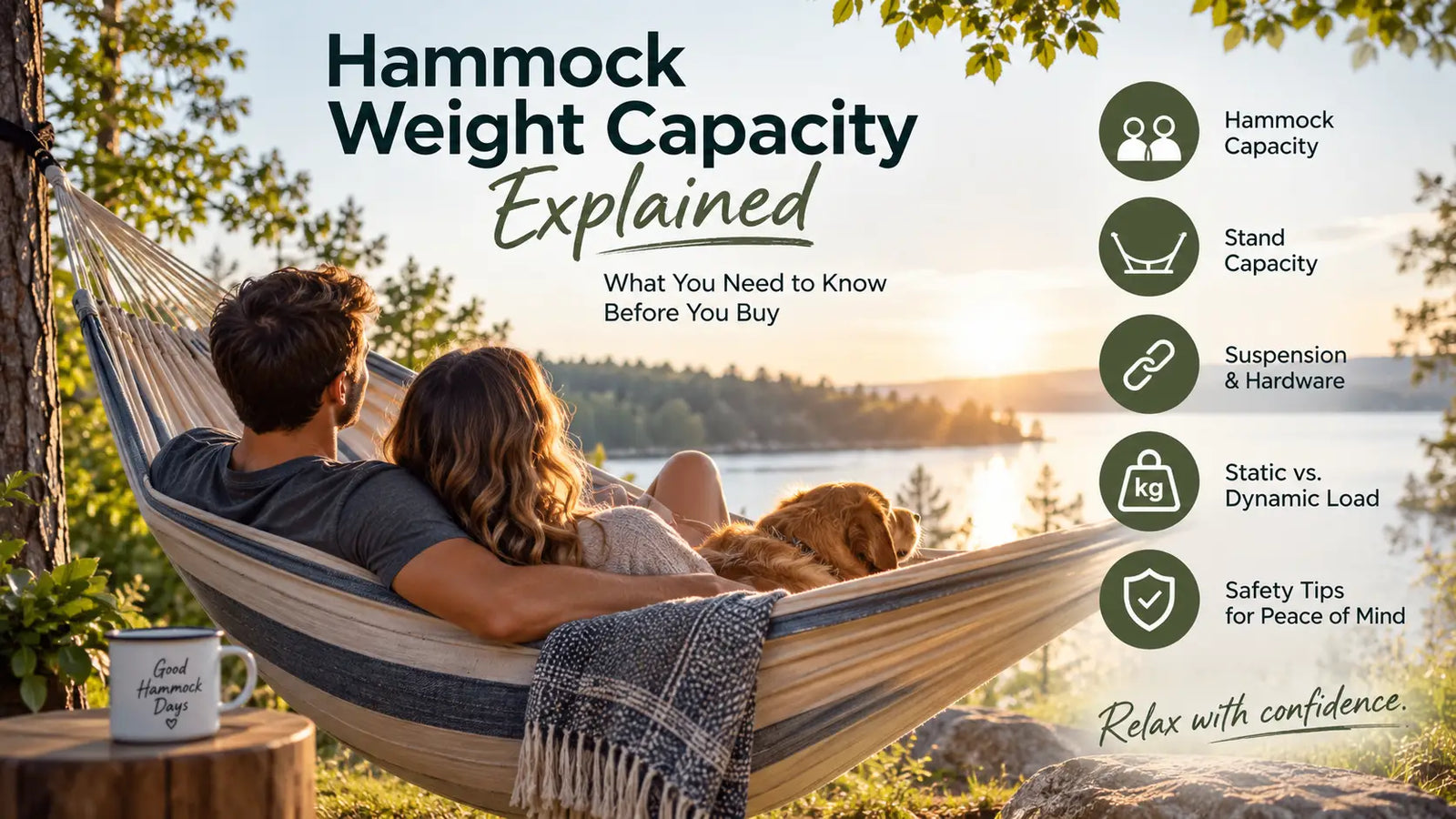
Hammock Weight Capacity Explained: What You Need to Know Before You Buy

Audio Version
Hammock Weight Capacity Explained: What You Need to Know Before You Buy
“How much weight can a hammock hold?” sounds like a simple question.
The answer printed on a product page might be simple—300 pounds [136 kg], 450 pounds [204 kg], 800 pounds [363 kg]—but understanding what that number means is more important than simply finding the hammock with the largest rating.
You also have to consider the stand, suspension hardware, anchor points, number of occupants and how the hammock is being used.
Quick answer: A hammock’s listed weight capacity is the maximum load specified for that hammock under normal intended use. If you use a stand, the safe limit of the complete setup is determined by its lowest-rated component. A 500-pound [227 kg] hammock on a 450-pound [204 kg] stand is therefore a 450-pound [204 kg] setup—not a 500-pound [227 kg] setup.
Hammock Weight Capacity vs. Hammock Size
The first thing to understand is that size and weight capacity are not the same thing.
Terms such as:
single;
double;
XL; and
family size
usually describe the intended size or usable space of the hammock.
They do not replace the actual weight rating.
A large hammock may have a high capacity, but you should never assume its rating based on dimensions or its name.
Always check the specifications for the exact model.
How Much Weight Can a Hammock Hold?
There is no universal hammock weight limit.
Different constructions, materials and designs carry different manufacturer ratings.
A Brazilian fabric hammock, a Mayan woven hammock and a poolside spreader-bar hammock may all have different capacities even if they are marketed as double hammocks.
This is exactly why the product specification matters more than a general statement such as:
“A double hammock can hold two people.”
Two adults whose combined weight is 350 pounds [159 kg] represent a very different load from two adults whose combined weight is 500 pounds [227 kg].
The Entire Hammock System Matters
A hammock does not support you by itself.
Your complete setup may include:
the hammock;
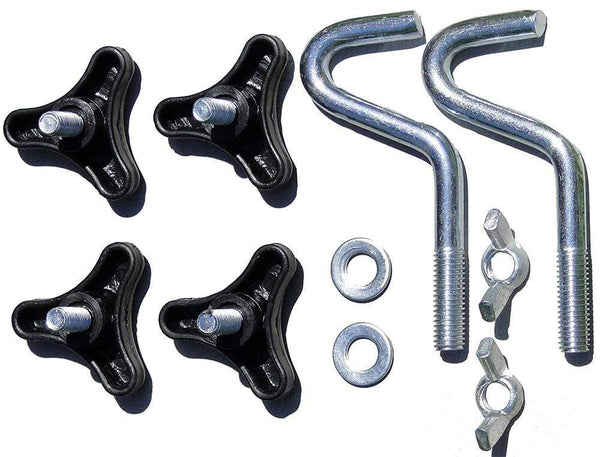
straps, ropes, chains or suspension;
hooks or carabiners;
a hammock stand or fixed anchors; and
the structure supporting those anchors.
Each component must be suitable for the intended load.
Think of the complete setup as a chain.
The highest-rated component cannot compensate for the lowest-rated one.
A Simple Example
Suppose you pair a hammock rated for 500 pounds [227 kg] with a stand rated for 450 pounds [204 kg].
The stand becomes the limiting component.
Your complete setup should therefore be treated as a 450-pound [204 kg] setup, assuming all other components are also properly rated and installed.
The extra capacity of the hammock does not increase the capacity of the stand.
Static Weight vs. Dynamic Load
This distinction is important and often overlooked.
Static weight is the relatively steady load created when someone carefully enters the hammock and rests normally.
Dynamic load occurs when movement adds additional forces.
Examples include:
bouncing;
swinging aggressively;
dropping suddenly into the hammock;
children using the hammock as playground equipment; or
rapid changes in body position.
Those movements can temporarily place significantly more force on the hammock and support system than the occupants’ body weight alone.
That is one reason a hammock should be treated as a resting device, not a swing or trampoline.
The weight listed in the specifications should never be interpreted as permission to generate additional forces through aggressive movement.
Does a 450-Pound [204 kg] Hammock Mean Two 225-Pound [102 kg] People Can Always Use It?
Not automatically.
Mathematically, two people weighing 225 pounds [102 kg] each total 450 pounds [204 kg].
But it is not a good idea to deliberately plan a setup around operating exactly at its published maximum.
You still need to consider:
the stand or anchors;
the suspension;
accessories;
normal movement;
wear and age;
proper installation; and
the condition of every component.
A rated maximum is a limit, not a target.
If your expected load is very close to the maximum, choosing a higher-capacity setup can provide more practical margin.
Do Pillows, Blankets and Accessories Count?
Yes.
Anything supported by the hammock contributes to the load.
That may include:
occupants;
pillows;
blankets;
sleeping bags;
pets; and
anything else resting in the hammock.
A pillow may not add much weight on its own, but the correct way to think about capacity is total supported load, not simply the weight of the largest person.
What Does “Double Hammock” Actually Mean?
A double hammock generally gives you a wider or larger lounging area intended to accommodate two people.
It does not mean that every double hammock has the same capacity.
For example, the Deluxe Brazilian Style Double Hammock and the Mayan Hammock – Double are both double hammocks.
Their construction, dimensions and rated capacities are not identical.
This is why the specification table should always take priority over the product category.
What About Family-Sized Hammocks?
A family-sized hammock usually provides substantially more usable bed area and may also offer a much higher rated capacity.
That does not mean you should simply keep adding people until the scale reaches the maximum number listed on the product page.
You still need:
sufficient physical room;
a suitable support system;
safe entry and exit;
appropriate supervision around children; and
a stand or anchors capable of supporting the intended setup.
A high-capacity hammock paired with a lower-capacity stand is still limited by the stand.
Pay Special Attention to Hammock Stand Capacity
This is one of the easiest mistakes to make.
Hammock shoppers sometimes focus entirely on the hammock’s capacity and overlook the stand.
For example, if you place a high-capacity hammock on the Universal Hammock Stand for Non-Spreader-Bar Hammocks, the stand’s own rating still applies.
Similarly, a spreader-bar hammock paired with a steel stand must stay within the specifications of both products.
Always compare the two numbers before ordering a hammock-and-stand combination.
What If You Hang Between Trees Instead?
Removing the stand does not remove the need to think about capacity.
The trees, straps, attachment hardware and every connection point must all be appropriate for the expected load.
Never assume that a tree is suitable simply because it looks large.
Use healthy, structurally sound supports and hammock suspension designed for the intended application.
For more on choosing and measuring a hanging location, see How to Measure Your Space for a Hammock: Distance, Height & Stand Compatibility.
Our Hammock Safety Tips also cover installation and inspection in more detail.
Does the Hanging Angle Affect the Forces on the Setup?
Yes.
Pulling a traditional hammock extremely tight may look secure, but a flatter suspension angle can dramatically increase the tension transmitted to the anchors and suspension.
A traditional hammock is designed to hang with a natural curve.
This is another reason why proper installation matters independently of the hammock’s stated weight capacity.
Use the Hammock Universe Hang Calculator when planning your setup and follow the instructions for the exact product you are using.
Does Hammock Capacity Change as the Hammock Gets Older?
The printed specification does not gradually change as the hammock ages, but the condition of the product absolutely matters.
Over time, inspect for:
worn fabric;
frayed rope;
damaged end loops;
broken cords;
corrosion;
bent hardware;
damaged chains;
cracked wood components;
loose stand hardware; and
other signs of deterioration.
If a hammock or support component is damaged, do not assume its original rating still represents what the damaged product can safely support.
Replace or properly address damaged components before use.
Should You Buy More Capacity Than You Think You Need?
Often, having some practical margin makes sense.
You do not need to buy the highest-capacity hammock available simply because its number is larger.
Instead, consider:
who will normally use it;
whether it will frequently be shared;
whether children or pets may join;
the stand or hanging system you intend to use;
how much lounging space you want; and
the exact manufacturer’s specifications.
For one person, a properly rated standard hammock may be entirely appropriate.
For couples or families, a wider hammock with additional rated capacity may make more sense.
The goal is not to maximize the number.
The goal is to choose a complete setup suited to how it will actually be used.
A Simple Weight-Capacity Checklist
Before buying or using a hammock setup, confirm:
Hammock capacity — What is the exact manufacturer’s rating?
Stand capacity — If using a stand, is its rating appropriate for the expected load?
Suspension capacity — Are straps, chains, hooks and other hardware suitable?
Total load — Have you counted everyone and everything supported by the hammock?
Condition — Is the hammock and all hardware free of damage?
Compatibility — Is the hammock designed to work with this stand or support system?
Use — Will the hammock be used for resting rather than jumping, bouncing or aggressive swinging?
If one of those answers is uncertain, resolve it before using the hammock.
Frequently Asked Questions
How much weight can a double hammock hold?
It depends on the model. “Double” describes size or intended occupancy, not a standardized load rating. Always check the exact product specifications.
Can I exceed the hammock limit by a few pounds?
No. The published maximum should be respected. If your expected load is close to or above the rating, select a higher-capacity hammock and support system.
If my hammock holds 800 pounds [363 kg] but my stand holds 450 pounds [204 kg], what is my limit?
The stand is the lower-rated component, so the complete setup is limited by the stand’s 450-pound [204 kg] rating, assuming all other components are also appropriate.
Does swinging increase the load?
Movement can generate forces beyond static body weight. Hammocks should therefore be used as resting devices and not for jumping, bouncing or aggressive swinging.
Do children count toward the weight capacity?
Yes. Every occupant contributes to the total load.
Does my dog count?
Yes. A pet in the hammock adds to the total supported load.
Is a higher weight capacity always better?
Not necessarily. Capacity is only one factor. Size, material, hammock style, available space, stand compatibility and intended use also matter.
Capacity Is About the Complete Setup
The most important number is not necessarily the largest number on the page.
A hammock’s weight capacity tells you what that hammock is rated to support.
Your actual setup is only as capable as its lowest-rated component.
So before buying—or before inviting one more person into the hammock—check the hammock, stand, suspension and supports together.
Then relax within the limits the equipment was designed to handle.
Browse all hammocks and hammock stands to build a setup that matches your space, preferred hammock style and expected load.
Safety First!
When using a hammock*, safety is paramount. Please make sure to follow these important guidelines when purchasing, installing and using a hammock
*(includes Hammock, Hammock Chair, Hammock Stand and Hammock Accessories)

Hammock Universe Canada
$409.88 CAD$399.88 CAD


Hammock Universe
$469.94 CAD$379.94 CAD






Hammock Universe Canada
$77.91 CAD$73.91 CAD

Hammock Universe Canada
$168.91 CAD$135.91 CAD


