

How to Measure Your Space for a Hammock: Distance, Height & Stand Compatibility

Audio Version
How to Measure Your Space for a Hammock: Distance, Height & Stand Compatibility
One of the easiest hammock-buying mistakes happens before the hammock even arrives: not measuring the space first.
A hammock that is too long for its location, a stand that does not match the hammock style, or anchor points that require an awkward setup can turn an exciting purchase into a frustrating one.
Fortunately, you do not need complicated calculations to get started.
Quick answer: Measure the clear distance between your intended hanging points, check the hammock's overall length and recommended hanging distance, decide whether you will use fixed anchors or a stand, and verify that the support system is compatible with your exact hammock type. Never rely on the words “single,” “double” or “universal” alone.
Step 1: Decide Where the Hammock Will Go
Before measuring anything, choose the actual location.
That might be:
- between two suitable trees;
- between properly designed structural anchor points;
- on a patio or deck with a hammock stand;
- at the cottage;
- indoors with an appropriately designed installation; or
- in an open area where a freestanding stand is the better solution.
Look at the entire space—not only the distance between two points. You also need room around the hammock for safe access and a suitable surface below it.
If you are considering outdoor anchor points, our Ultimate Guide on Hanging Hammocks Outdoors is a useful companion guide.
Step 2: Identify the Hammock Type
Before deciding what measurements you need, determine whether the hammock has spreader bars.
A spreader bar hammock stays open because rigid bars stretch the bed at both ends. A traditional hammock, including many Brazilian, Colombian, Mayan and Nicaraguan models, gathers at its ends without rigid bars.
Why does this matter?
Because these two styles do not necessarily use the same hanging geometry or the same stands.
A stand made for a non-spreader-bar hammock should not automatically be used for a spreader bar model, and vice versa.
Step 3: Measure the Distance Between Your Anchors
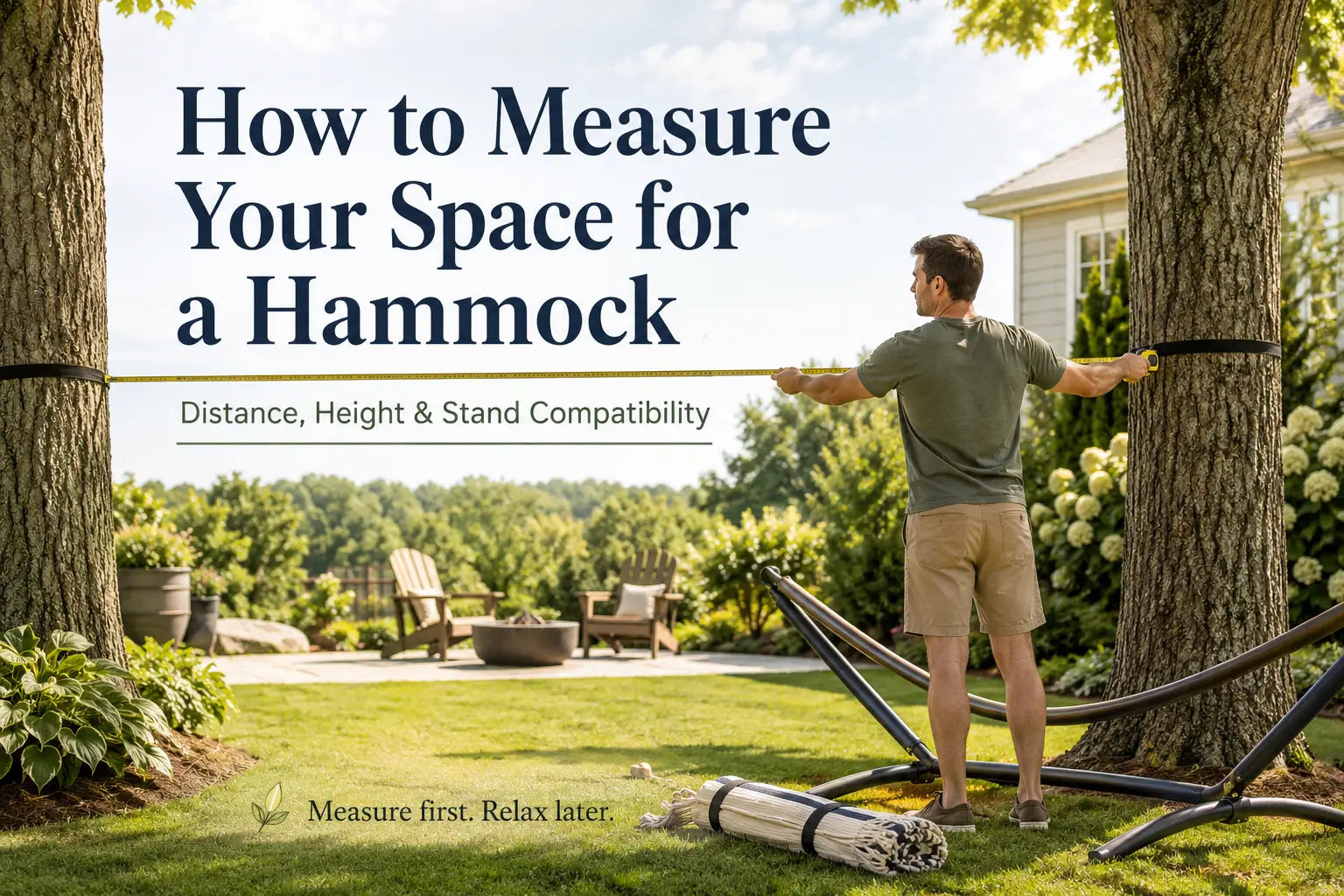
If you are hanging between two fixed points, measure the horizontal distance from one intended anchor to the other.
Write the number down rather than estimating it visually.
Then compare it with the recommended hanging distance for the exact hammock you are considering.
For example:
| Hammock | Type | Overall Length | Recommended Hanging Distance |
|---|---|---|---|
| Poolside | Lake Hammock – Double | Spreader bar | 13 ft | 13+ ft |
| Deluxe Brazilian Style Double Hammock | Traditional | 10.5 ft | 11+ ft |
These examples demonstrate why one universal measurement rule cannot work for every hammock.
A hammock's product specifications should be your starting point.
Step 4: Do Not Confuse Hammock Length With Bed Length
Product pages may show several different measurements.
Overall hammock length generally refers to the full end-to-end length of the hammock.
Bed length refers to the area intended for the user.
Those are not interchangeable.
A hammock with a six-foot lounging bed can still have an overall length of 13 feet once the suspension and end sections are included. If you measure your available space using only the bed size, the hammock may not fit.
When planning an installation, look for the overall length and recommended hanging distance.
Step 5: Consider Hanging Height and Sit Height
Distance is only half of the setup.
The height of the attachment points influences the hammock's sag and the position of the loaded hammock.
Traditional hammocks are normally installed with some sag rather than pulled tight like a cable. The appropriate geometry changes according to anchor distance, hammock length and suspension.
Instead of guessing, use the Hammock Universe Hang Calculator. It lets you enter the distance between anchors, hammock or ridgeline length, preferred sit height, expected load and hang angle.
Remember that the calculator is an estimating tool. The actual product instructions, hardware requirements and safe condition of the support structure still come first.
Step 6: Keep the Hammock Low
A hammock should be installed as a low resting device rather than an elevated platform.
Hammock Universe's current safety guidance specifies that a hammock should rest only inches above the ground when loaded and should never be hung higher than 18 inches above the ground.
Also consider what is underneath the hammock. A soft, forgiving area is preferable to sharp, hard or hazardous surfaces.
This is one measurement where “higher” is definitely not better.
Step 7: Measure for a Hammock Stand Differently
If you do not have suitable anchor points, a hammock stand may be the simplest option.
In that case, your first concern becomes the footprint of the stand itself.
Measure:
- available floor or ground length;
- available width;
- clearance around the stand;
- the hammock type the stand accepts; and
- the weight capacity of both hammock and stand.
For example, the Hammock Universe Universal Hammock Stand for Non-Spreader-Bar Hammocks has a footprint of approximately 9.5 feet long by 4 feet wide and is designed for gathered-end hammocks without spreader bars.
The word universal in a product name should never replace reading the compatibility specifications.
Browse the hammock stand collection and match the stand to the hammock—not simply to the available floor space.
For additional background, see Hammocks With Stands – Your Questions Answered.
Step 8: Check More Than Dimensions
A hammock can physically fit in a space and still be the wrong setup.
Before installation, also verify:
- the manufacturer's weight capacity;
- the condition of the hammock;
- the condition and rating of the hanging hardware;
- stand compatibility;
- the condition and suitability of anchor points;
- overhead hazards;
- the surface beneath the hammock; and
- adequate room to enter and exit safely.
Inspect the hammock, hardware and support system before every use. If you are uncertain whether a permanent anchor or structure is suitable, use qualified professional assistance rather than guessing.
Our Hammock Safety Tips cover these considerations in more detail.
A Simple Pre-Purchase Hammock Measurement Checklist
Before clicking “Add to Cart,” confirm these seven points:
- Available distance: How much clear length do you actually have?
- Hammock type: Spreader bar or traditional?
- Overall hammock length: What is the full end-to-end measurement?
- Recommended hanging distance: What does the product page specify?
- Support method: Fixed anchors or hammock stand?
- Stand compatibility: Is the stand designed for this hammock style and size?
- Safe loaded height: Can the hammock remain low to the ground when occupied?
If all seven answers work together, you are much more likely to end up with a setup that fits correctly.
Frequently Asked Questions
How much space do I need for a hammock?
There is no single distance that fits every hammock. Check the overall length and recommended hanging distance for the specific model, then compare those figures with your measured location.
How far apart should two trees be for a hammock?
The correct distance depends on the hammock's length, style and suspension. Measure the trees first, then check the hammock specifications or use a suitable hang calculator rather than relying on a universal number.
How high should a hammock be from the ground?
Hammock Universe recommends keeping the occupied hammock only inches above the ground and never higher than 18 inches.
Can I use chains or straps if my anchors are farther apart?
Properly rated suspension can sometimes accommodate additional distance, depending on the hammock and installation. Use components designed for hammock use, stay within all ratings and follow the manufacturer's setup instructions.
Can any hammock fit any hammock stand?
No. Stand length, attachment geometry, hammock style and weight capacity all matter. In particular, spreader-bar and non-spreader-bar hammocks often require different stand designs.
What if I do not have two trees?
A compatible hammock stand can provide a freestanding solution. Measure the stand's complete footprint and verify hammock compatibility before buying.
Measure First, Relax Later
The best hammock setup starts with a tape measure.
Knowing your available space before you shop helps you choose the right hammock style, avoid incompatible stands and understand how the finished setup will fit your backyard, patio, cottage or indoor space.
Once you have your measurements, use our Hammock Hang Calculator, compare the specifications on the hammock you are considering, and choose a support system designed for that exact setup.
A few minutes of measuring can make the difference between trying to make a hammock fit and choosing one that fits from the start.
Safety First!
When using a hammock*, safety is paramount. Please make sure to follow these important guidelines when purchasing, installing and using a hammock
*(includes Hammock, Hammock Chair, Hammock Stand and Hammock Accessories)

Hammock Universe
$649.97 CAD$499.97 CAD


Hammock Universe
$469.94 CAD$379.94 CAD


Hammock Universe Canada
$77.91 CAD$73.91 CAD

Hammock Universe Canada
$409.88 CAD$399.88 CAD


