Spreader Bar vs. Traditional Hammocks: Which Is Right for You?

Audio Version
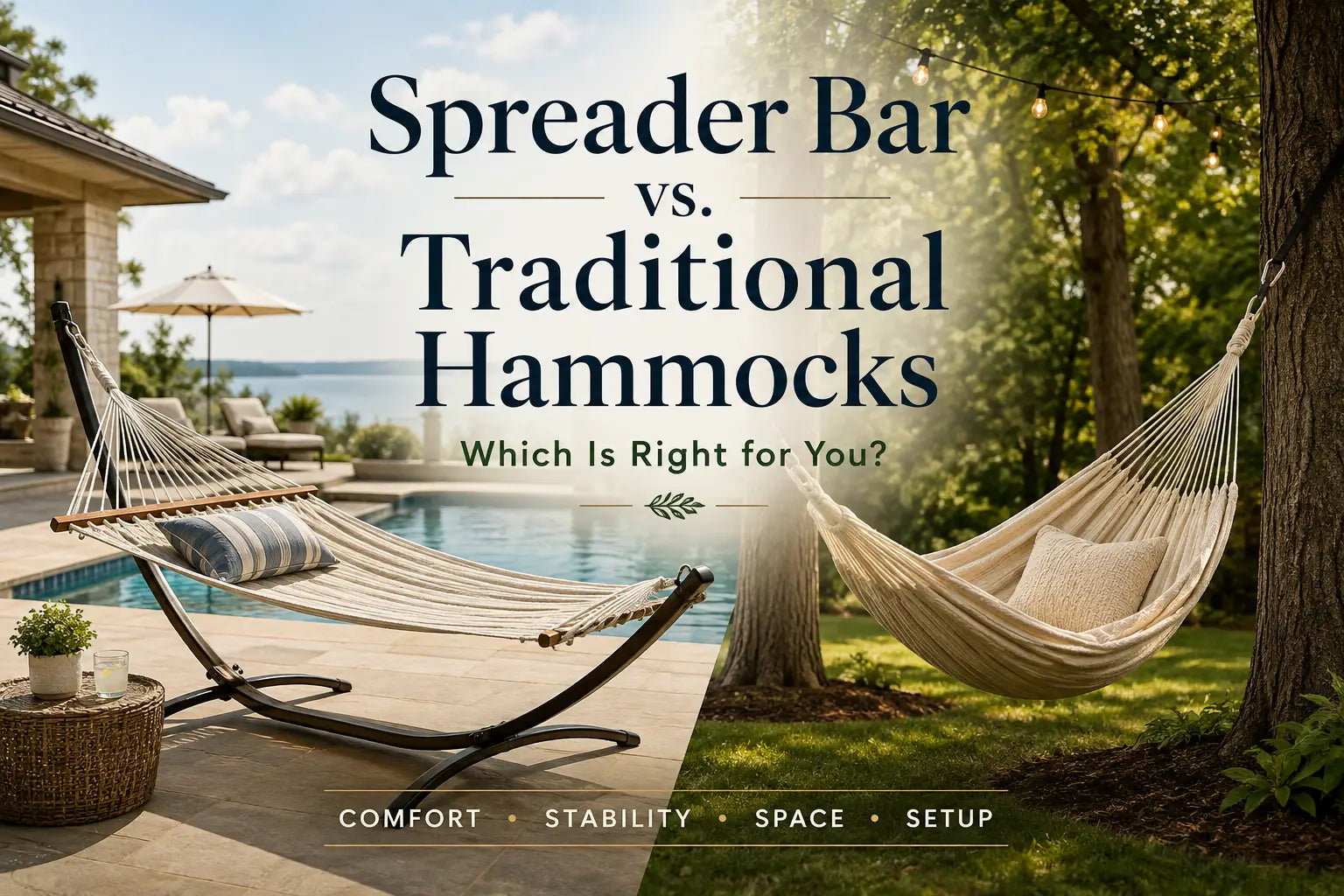
Spreader Bar vs. Traditional Hammocks: Which Is Right for You?
Shopping for a hammock sounds simple until you discover one of the biggest differences between hammock designs: spreader bar vs. traditional.
Both can create an excellent place to relax, but they look, feel and hang differently. The better choice depends on where you plan to use your hammock, how much space you have and the type of lounging experience you prefer.
Quick answer: A spreader bar hammock uses a rigid bar at each end to keep the hammock bed open and relatively flat. A traditional hammock has no spreader bars, allowing the fabric or weave to curve naturally around the user. Spreader bar hammocks are especially popular for patios, poolsides and open backyard displays, while traditional hammocks are a strong choice for relaxed, enveloping comfort and flexible hanging.
What Is a Spreader Bar Hammock?
A spreader bar hammock has a wooden or metal bar positioned at each end of the hammock bed. The suspension cords pass through or attach along these bars, keeping the lounging surface stretched open.
That open shape gives spreader bar hammocks their distinctive appearance. You can see most of the hammock bed even when nobody is using it, making this style a natural fit for a patio, deck, pool area or landscaped backyard.
Hammock Universe carries several styles in its spreader bar hammock collection, including rope, quilted, Olefin and poolside designs.
One example is the Poolside | Lake Hammock – Double. It combines wooden spreader bars with fast-drying Textilene fabric, making it particularly well suited to wet environments such as a pool, dock or lakeside deck.
What Is a Traditional Hammock?
A traditional hammock does not use rigid spreader bars. Instead, the fabric or woven body gathers toward the suspension point at each end.
This creates the familiar curved hammock shape. When you lie down, the hammock conforms around your body rather than remaining stretched open.
Brazilian, Colombian, Mayan and Nicaraguan hammocks are common examples. You can explore them in the traditional hammock collection.
The Deluxe Brazilian Style Double Hammock, for example, uses a soft cotton-polyester fabric without spreader bars and is designed for use between suitable hanging points or with a compatible non-spreader-bar stand.
Spreader Bar vs. Traditional Hammock at a Glance
| Feature | Spreader Bar Hammock | Traditional Hammock |
|---|---|---|
| Hammock bed | Held open by bars | Gathers naturally at both ends |
| Feel | Open and flatter | Curved and enveloping |
| Appearance when empty | Fully displayed | Hangs in a narrower curve |
| Typical backyard use | Pool, patio, deck, lawn | Backyard, cottage, patio, indoor or travel |
| Stand requirement | Spreader-bar-compatible stand | Non-spreader-bar-compatible stand |
| Space | Often requires a longer, more fixed span | Can offer more flexibility depending on model and suspension |
| Entry | Broad, visible lounging surface | Sit in the centre and let the hammock wrap naturally |
| Best choice for | Open lounging and visual presence | Relaxed, cocooning comfort |
There is no universal winner. The important question is which design better matches your space and the way you want to use it.
Which Hammock Feels More Stable?
Traditional hammocks tend to cradle the user because the fabric or weave can move around the body. That shape can feel reassuring to people who prefer to be surrounded by the hammock.
A spreader bar hammock remains more open. Because its bed is held flat, body position and weight distribution can have a greater effect on how the hammock reacts when entering, exiting or shifting position.
Whichever style you choose, a hammock is a resting device—not a swing. Enter slowly, keep unnecessary movement to a minimum and always follow the product's installation and weight-capacity instructions.
For more installation guidance, see our Hammock Safety Tips: How to Secure Your Hammock Like a Pro.
Which Style Is Better for a Pool or Lake?
A spreader bar hammock can be especially practical around a pool or lake because the open bed is easy to approach and certain models are specifically built with outdoor, fast-drying materials.
The material matters just as much as the shape, however. A cotton spreader bar hammock and a Textilene poolside hammock should not be treated as if they have identical weather resistance.
If water exposure is part of your plan, look at the product specifications rather than assuming every outdoor hammock can remain outside indefinitely.
Which Style Is Better for Long Relaxing Sessions?
Many people enjoy traditional hammocks for longer periods because the fabric can support the body in a naturally curved position. A wide traditional hammock also lets you experiment with a slightly diagonal position rather than lying rigidly from end to end.
Other people prefer the broad, open feel of a spreader bar hammock.
Comfort is personal, so the better question is not “Which hammock is most comfortable?” but “Which hammock shape feels most comfortable to me?”
If material is also part of your decision, our older guide Rope vs. Fabric Hammocks – Which Is Better? explains another important difference between hammock designs.
Do Spreader Bar and Traditional Hammocks Use the Same Stand?
Not necessarily—and this is one of the most important differences to check before buying.
A stand designed for a gathered-end traditional hammock may not be suitable for a spreader bar hammock. The length, attachment position and geometry are different.
For example, Hammock Universe's Universal Hammock Stand for Non-Spreader-Bar Hammocks is specifically designed for traditional hammocks without spreader bars. It should not be used as though it were a universal stand for every hammock style.
Always check both the hammock and stand specifications before combining components.
Which Hammock Is Best for a Small Space?
Start with measurements rather than the hammock category alone.
Some traditional hammocks can work with relatively compact adjustable stands, while many spreader bar hammocks require a longer span. But overall length and recommended hanging distance vary by model.
That means the product specifications—not a general rule—should make the final decision.
Before buying, measure the usable length and width of your location and compare those numbers with the hammock or stand you are considering.
How to Choose Between Them
Choose a spreader bar hammock if you want an open lounging surface, like the classic stretched-out appearance, or are looking at purpose-built poolside, rope or quilted models.
Choose a traditional hammock if you prefer a hammock that conforms around you, like Brazilian, Colombian, Mayan or Nicaraguan designs, or want to pair your hammock with a compatible gathered-end stand.
Still undecided? Start with three questions:
- Where will the hammock be used?
- How much measured space is available?
- Do you prefer an open bed or a hammock that wraps around you?
Once those answers are clear, choosing between the two styles becomes much easier.
Frequently Asked Questions
Are spreader bar hammocks better than traditional hammocks?
Neither style is automatically better. Spreader bar hammocks provide an open, stretched lounging surface, while traditional hammocks provide a more enveloping shape. The best choice depends on your space and personal comfort preference.
Are traditional hammocks safer?
Safety depends primarily on correct installation, compatible supports, condition, weight capacity and proper use. Do not choose a hammock based on style alone and assume that makes the setup safe.
Can I put a traditional hammock on a spreader bar stand?
Only if the stand manufacturer specifically confirms compatibility with that hammock type and size. Do not assume stands are interchangeable.
Can two people use either style?
Many double hammocks are designed for two occupants, but always follow the stated weight capacity and product instructions. “Double” does not mean unlimited capacity.
What should I check before buying?
Check hammock type, overall length, recommended hanging distance, weight capacity, stand compatibility, materials and care requirements. Then compare those specifications with the location where you plan to use it.
Find the Hammock Style That Fits You
The best hammock is not simply the one that looks best in a photo. It is the one whose design, dimensions, materials and support system fit the way you actually plan to relax.
Compare our traditional hammocks and spreader bar hammocks, check the specifications carefully, and build your setup around the space you really have.
Safety First!
When using a hammock*, safety is paramount. Please make sure to follow these important guidelines when purchasing, installing and using a hammock
*(includes Hammock, Hammock Chair, Hammock Stand and Hammock Accessories)